
Cabot Directory Sources by Era
Cabot does not have a verified, published run of stand-alone printed directories. Its population was only 294 in 1900, and most growth came after World War II. The honest collection plan therefore joins sources that name people, places, and households at different dates. The Cabot Herald and Cabot Star-Herald survive on microfilm through Lonoke County Libraries. Census schedules, marriage books, probate images, the city plat, and the single located Sanborn map supply other fixed points. Telephone books or reverse listings may exist locally, but no official shelf list gives their titles or years.
| Collection | Years | Where Held | Access |
|---|---|---|---|
| Cabot Herald and Star-Herald | Exact runs not published | Lonoke County Libraries | Microfilm; ask branch staff or genealogist |
| Federal census schedules | 1880 to 1950 relevant and public | NARA and genealogy databases | Online databases or library access |
| Lonoke County marriages | 1873 to 1951 | FamilySearch; courthouse originals | Online collection and 24 microfilm reels |
| Arkansas probate images | 1817 to 1979 statewide; county varies | FamilySearch | Free account; browse images |
| Cabot Sanborn map | July 1913 | Library of Congress | Free digitized map |
| Telephone or reverse directories | Local years unverified | Ask the county library genealogist | Itemized catalog and physical-volume check |
This coverage table is deliberately broader than a conventional Cabot city directory list. No official source names a local publisher, printed year run, digitized volume, or criss-cross series. Absence from an online catalog is not proof that no physical volume exists. It means the next step is an itemized search with the county library genealogist. Record a volume's full title, publisher, date, and call number before treating it as Cabot coverage.
Cabot Directory Help at the Library
The Cabot Public Library is at 909 W. Main Street. It is open Monday through Thursday from 9 a.m. to 7 p.m., Friday from 9 a.m. to 5 p.m., and Saturday from 10 a.m. to 2 p.m. The branch phone is 855-572-6657, option 01. Its county system offers genealogy classes, one-on-one help, research consulting, local documents, newspaper databases, and appointments with a genealogist. Those channels matter when a catalog search does not reveal a local volume.
The official Cabot branch page shows the local desk and its service context.

The branch is the practical place to ask for newspaper microfilm, local history material, and a precise search for telephone or directory holdings.
Bring names, a rough date span, and any known street, spouse, school, church, or firm. Ask staff to check title variants and countywide material, not just items cataloged under Cabot. The library also supports oral-history and microfilm-conversion work through its genealogy program. Those local projects may preserve a name or place that never appeared in a formal printed list.
Cabot Directory Clues on Microfilm
Cabot newspaper microfilm fills the long gaps between federal census releases. Search the Cabot Herald and Cabot Star-Herald for obituaries, weddings, legal notices, property sales, business ads, school lists, and social notes. Each item answers a narrow question. A business ad may link a person to an occupation and street. An obituary may supply relatives and an earlier community. A legal notice may give a lot description or estate name.
A separately cataloged lead called “Obituaries, where to find them in the Cabot paper” covers 1927 through 1999 and is reported in a secondary catalog as containing 23,685 entries. Its present shelf or database access was not verified. Ask the genealogist to confirm the title and location before relying on it. That caution keeps a promising lead from being mistaken for an immediately searchable online index.
Note: Search married names, maiden names, initials, suffixes, and spelling variants because newspaper indexing and optical character recognition can split one person into several forms.
Growth Changed Cabot Directory Evidence
The Encyclopedia of Arkansas Cabot history explains the city's railroad origin and sharp postwar growth.
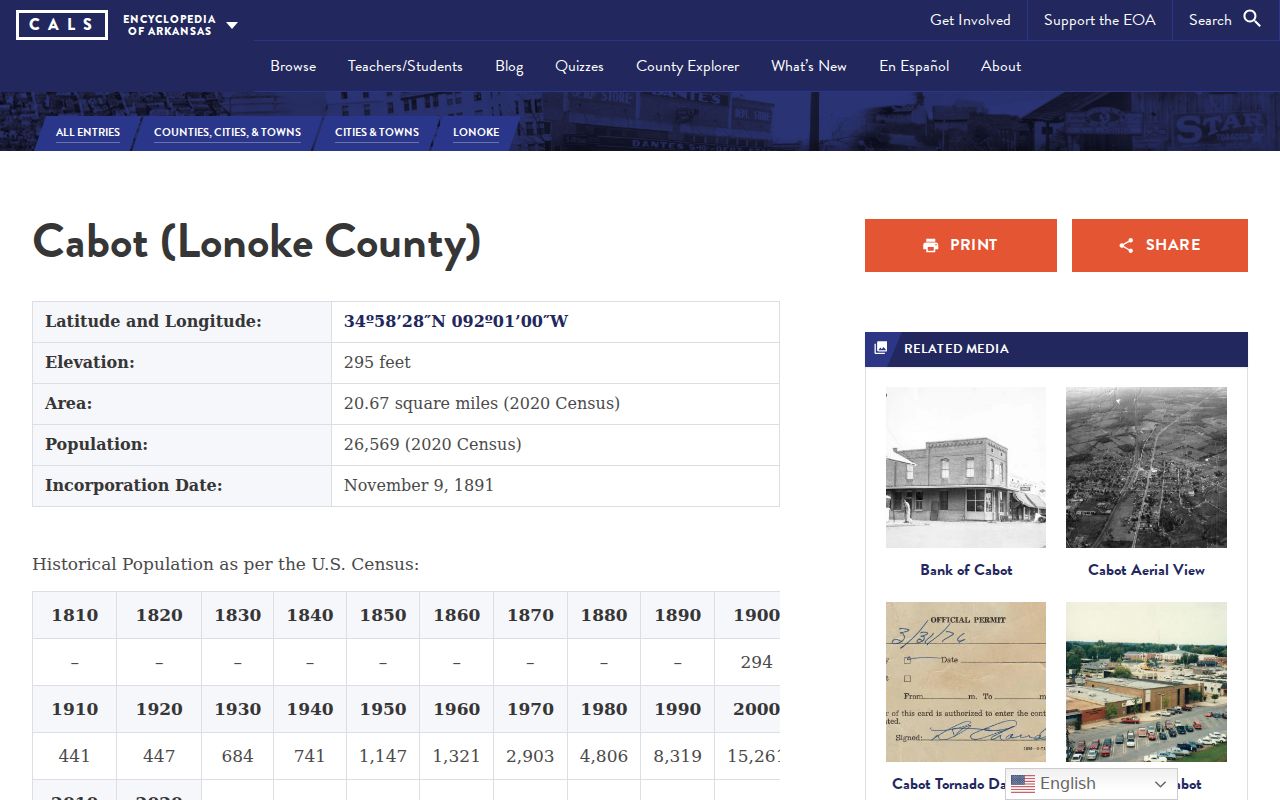
That history explains why farm records, county deeds, churches, and newspapers often work better than a printed volume for early Cabot residents.
Cabot grew from 2,903 residents in 1970 to 26,569 in 2020. That more than ninefold rise makes a single “directory era” misleading. Older searches cluster around rural routes, the railroad, farms, church life, and the courthouse. Newer subdivisions leave stronger trails in plats, parcel maps, permits, school annuals, business filings, and digital records. Treat each era as a different records problem.
Read Cabot City Directory Entries
No authoritative digital Cabot directory page was available for a local sample inspection. The fields below are directory conventions, not claims about a specific Cabot volume. Before using any physical book, photograph its title page and abbreviation key when rights and library rules allow. Then inventory only what that edition actually prints. Older books often compress many facts into short lines, and a mark can change meaning from one publisher to another.
| Name | Surname, given name or initials; head-of-household status depends on the volume |
|---|---|
| Spouse or widow note | A spouse may appear in parentheses; widow or widower wording can point to a death search |
| Work line | Occupation and sometimes the employer or business address |
| Residence | House number and street, rural route, or another place label used at that date |
| Owner or renter mark | Some publishers use an occupancy symbol; accept it only when that volume's key defines the mark |
| Telephone | May appear in a telephone book or later directory, but omission has several possible causes |
- Criss-cross directory
- A section arranged by street and house number instead of surname. Cabot holdings must be verified before use.
- Householder index
- A list centered on the named person associated with a household, which may omit other occupants.
- Abbreviation key
- The publisher's legend for short forms and symbols. It often appears in the volume's front matter.
Do not turn a missing line into a firm conclusion. A person may have moved, lacked a listed telephone, used rural delivery, lived outside the directory's limits, or asked to be unlisted. A second record must decide among those possibilities.
Cabot Directories Meet Map Evidence
Cabot's city plat was filed at the Lonoke courthouse on September 25, 1891. It gives the first stable lots, blocks, and street framework for the new municipality. The July 1913 Cabot Sanborn map adds building footprints, materials, uses, and street names. It does not name occupants. Together, the plat and map can place an old directory address even when the modern number differs.
The sequence matters. Lonoke County was created in 1873. Cabot began as a railroad water and fuel stop after the Cairo and Fulton Railroad bypassed Austin that same year, then incorporated in 1891. An early resident may be indexed under Austin, rural Lonoke County, a township, or railroad context rather than Cabot. Search by land description and nearby institutions when the town name yields nothing.
The city plat and historic land books are courthouse records, not promised online images. Ask the Lonoke County Circuit Clerk, ex-officio recorder, for the recorded plat, or use the county clerk's vault room for title and genealogy work. Supply Cabot, the record type, and a narrow date or lot-and-block lead so staff can route the request without being asked to conduct open-ended research.
Companions to Cabot City Directories
Marriage, probate, school, church, and cemetery sources add relationships that a name-and-address line lacks. Lonoke County marriage volumes cover 1873 through 1951 on 24 microfilm reels, with indexes at volume fronts and an online county-marriage collection. Arkansas probate images span 1817 through 1979 statewide, though Lonoke County coverage varies. A free FamilySearch account may be required, and some images can depend on custodian or affiliate access.
School annuals, photos, and local museum holdings can help reconnect classmates across generations. Church leads include Ebenezer Cumberland Presbyterian records from 1883 through 1914 and the Mt. Pleasant Missionary Baptist centennial history. These are catalog or archival leads, not public modern membership lists. Cabot historical research should respect access rules and verify names against primary records.
Trace Families Across Cabot Directories
Start from a record with a firm date. The 1950 census is the newest public federal census under the 72-year rule. A deed, marriage, probate event, or known newspaper item can serve the same role. Copy names exactly, along with relationships, age, birthplace, occupation, and the full place or address. Then move outward in small steps.
- Anchor the household in the 1950 census or a dated deed, marriage, probate, or newspaper event.
- Search Cabot newspaper microfilm between census years for names, relatives, work, school, and address clues.
- Ask the library to inspect verified telephone or directory holdings by surname and address. Use a reverse section only if that volume has one.
- Pair the address with the 1891 plat, 1913 Sanborn map, assessor parcel, and recorder deed when a street label shifts.
- Move forward or back one year at a time, testing each change against another record.
A spouse note, occupation change, vanished listing, or new name at the same address is a clue, not a verdict. Obituaries and probate may explain death. Deeds can show a sale. Newspapers may reveal a move or rebuilding. For current address-keyed evidence, use the Cabot street directory workflow instead of forcing old shelf methods onto modern parcels.
Cabot Directory Timeline Anchors
Cabot's records timeline explains which source is most likely to name a person at each stage. It also prevents false precision about a directory run that has never been verified.
- 1873: Lonoke County was created, and Cabot developed beside a railroad stop after nearby Austin was bypassed.
- 1891: The Cabot plat was filed on September 25; incorporation followed on November 9.
- 1913: The only located Cabot Sanborn edition recorded streets and buildings in July.
- 1920s: Cabot gained limited electric service and a telephone system, so earlier searches should lean on deeds, census, churches, and newspapers.
- 1950: The newest public census now provides a household anchor before the city's largest growth years.
The March 29, 1976 tornado destroyed much of downtown and killed five residents. Later reconstruction can break a simple address trail. Compare newspaper accounts, deeds, permits, old photos, legal descriptions, and current parcels before assuming the same building survived. This story is central to reading Cabot records and map clues across the rebuilding period.